
Digitalisation and AI adoption
Before you invest in AI: find out where it pays off in your business.
Many companies have individual AI tools but no order of priorities. In a few weeks we work out where AI saves time in your business, what your existing systems can already do and what comes first. You end up with the most important immediate measures and a plan for the next 90 days.
No obligation. Vendor-neutral. No sales pressure.

Why companies come to us
- Employees already use AI tools, but without coordination and without rules.
- There are plenty of ideas, but no order of priorities and no budget for them.
- Data is retyped from one system into another instead of flowing automatically.
- Nobody knows which AI features in the existing software are already paid for.
- The EU AI Act requires measures, and it is unclear which ones.
Where you stand
Seven stages. Most SMEs are at stage two or three.
The model is a compass. It shows where your team stands today and which step comes next.
- 01
Unaware
AI is not a topic; some scepticism in the team.
- 02
Digitised
Excel, email and ERP are in place, AI is not yet.
Most companies are here
- 03
Potential recognised
Individuals experiment, but without a system.
Most companies are here
- 04
Strategic
A plan is in place, the first pilot projects are running.
- 05
Integrated
Embedded in core processes, with measurable results.
- 06
Scaling
Own AI agents; the team works with them independently.
- 07
AI-driven
AI shapes the business model; own servers.
Many companies are stuck between stage 2 and stage 3. The tools are there, a strategy is missing. People experiment without direction and invest without measuring. This is where our assessment starts.
Services
Each can be booked separately. You start where time is being lost.
- Fixed price · 2–4 weeks
Quick-win assessment
A structured way to find out where AI delivers the most: conversations with the departments, a look at your systems, and a rating by effort, benefit and risk. Result: the three most important immediate measures (quick wins) and a plan for 90 days.
Inventory of systems and licences
Which systems are running, who maintains them, what expires when? Which subscriptions do you pay for, and which are actually used? Where is data transferred by hand from one system to another? A frequent finding: part of the function you want is already paid for and simply not set up.
- 6–8 weeks
Implementing the quick wins
The most important measures go live in one short phase of work, from automatically routing incoming emails to answering questions from your own documents. Our development team builds them, and we measure the time gained.
Requirements specification and vendor selection
Where a solution is bought on the market, we write the requirements so that offers become comparable, and we check whether the result matches the requirements specification.
Governance, data protection, access rights
Roles and responsibilities for the use of AI, guidelines for everyday work (what may go into which tool), classification under the EU AI Act with documentation, and access rights linked to your existing user management.
- monthly
Ongoing AI coordination
For companies whose AI tools do not work together. We take on the coordination part-time, without you having to create a position: a monthly review, support when needed, planning per quarter.
Training for your employees has its own page.Go to AI training
Process
One contact person from the analysis to day-to-day operation.
- 01
Analysis
Where AI pays off and what your existing systems offer.
- 02
Requirements specification
Requirements that can be built or bought against.
- 03
Implementation
Our development team builds, or a selected vendor delivers. We check against the requirements specification.
- 04
Ongoing support
Operation, maintenance and further development, with a fixed contact person.
Expectations
No magic AI. Effects you can verify.
Every measure is measured: by time saved, error rate, throughput or response time. We name risks openly, and the plan stays realistic. How much AI achieves in an individual case depends on the business; the assessment shows what applies to yours.
Project examples
From our projects.

Mid-sized metal construction company
AI adoption from the study to implementation
- Task
- A workshop, on-site assembly and an office that handles many receipts, quotations and tenders every day. The management wanted to know where AI really takes work off people’s hands in their own business, with as little new software as possible and with sensitive data under their own control.
- Our contribution
- On-site workshops and conversations with the departments, resulting in a feasibility study with prioritised use cases. Basic training for the employees in two rounds. A comparison of the AI roadmaps of all software suppliers with the use cases, so that what the existing software can already do is introduced first. For the gaps (checking invoices against order and delivery, a knowledge base for tenders, standards and contracts), requirements and requirements specifications.
Transport and logistics
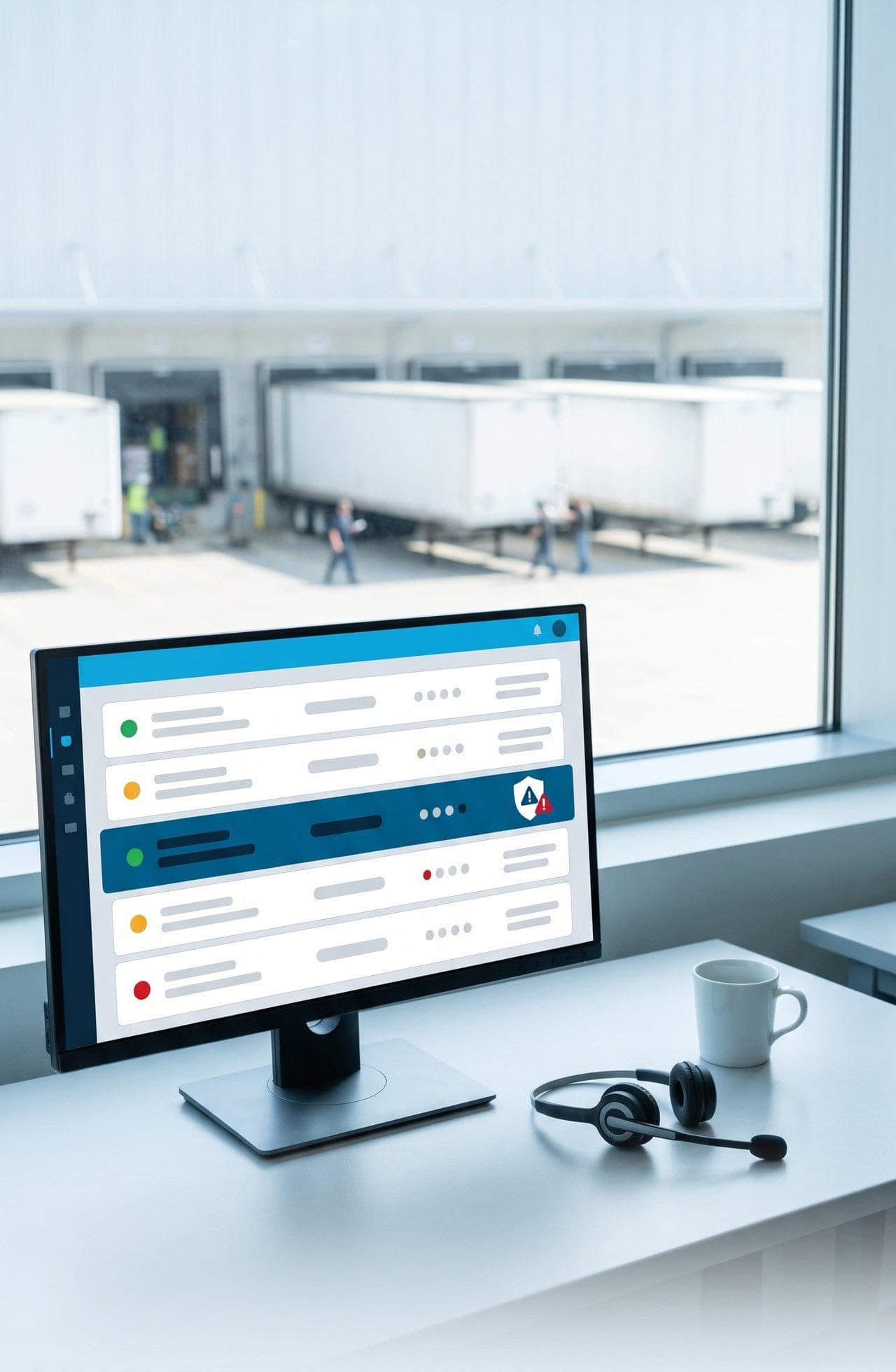
Protection against freight fraud when awarding orders
- Task
- Awarding orders to subcontractors often has to happen quickly. That is exactly where fraudsters step in, posing as carriers with a forged or hijacked identity. The risk of loss was to be reduced without rebuilding familiar processes and systems.
- Our contribution
- We recorded the requirements from day-to-day business, surveyed the market and demonstrated a suitable solution: before each order to a new carrier, the software checks the carrier’s details and shows the dispatcher the result as a traffic light with reasons. The decision stays with a person. The next step is a small, measured pilot at one site.

Software vendors from outside the EU
AI applications for the European market
- Task
- Software vendors from the USA and Asia are bringing new AI-supported applications to Europe, for transcription, office work and document management. They still know little about the European market. The applications need to fit European processes, expectations and rules.
- Our contribution
- We brought the European perspective into the service catalogue, all the way through to commissioning. Today we contribute to prioritisation and propose features that matter to European users.
Built in-house
Two solutions that show how we build AI.
- Knowledge & automation
Enterprise AI Knowledge & Automation Platform
Employees ask in plain language and get answers from the company’s own documents, with document and passage cited. AI agents take over recurring workflows. Runs on your own infrastructure, in the cloud or both.
- Recruiting
AI-powered IT staffing platform
Reads CVs in any layout and language, matches them against project requests and gives reasons for its suggestions. The profile goes out in the client’s template. The recruiting team makes the selection.
Your expert at Yanogo
Fernand Schroell
Consultant for AI adoption, digitalisation and connectivity
Graduate engineer in computer science with a focus on telecommunications (EPFL Lausanne), with 35 years in telecommunications and IT. At Siemens he worked in switching technology, in technical sales in France and on fixed mobile convergence. At Nokia Siemens Networks and Nokia he went on to serve as Head of Technology, as CTO for mobile networks in Europe and as lead architect for customer innovation and 5G. At Deutsche Bahn he was most recently responsible for technology and architecture in connectivity. Today he supports small and mid-sized companies for Yanogo in adopting AI and in all questions of networking, from office Wi-Fi to private 5G campus networks. He sees his role as a translator between management, business departments and IT.
I start with the problem and first look at what the existing systems can already do. Often part of the function people want has already been paid for and simply has not been set up.
FAQ
Frequently asked questions.
Do we need our own IT department for this?
No. Companies without their own IT team benefit in particular, because we translate between management, the departments and the IT service provider.
Will you end up selling us a particular piece of software?
No. We first check what your existing software can already do, and our recommendations are vendor-neutral. Where something has to be built, our development team can do it, but does not have to.
May our data leave the company?
We clarify that before every project. If documents must not leave the business, processing has to run in-house or in a European environment. Whether your technology can support that is part of the inventory.
What does the EU AI Act require of us?
Companies that use AI must ensure a sufficient level of AI literacy among their employees (Article 4). How they do so is up to them. We classify each application in practical terms; this does not replace legal advice.
How quickly will we see results?
The assessment takes two to four weeks. The first immediate measures typically go live in the six to eight weeks after that.
Contact
Let’s find out where AI pays off in your business.
In the free initial consultation you describe your situation and we ask questions. For your team there are also three training formats.
Free initial consultation
30 minutes. You describe your situation and we ask questions. Afterwards you know whether and where AI is worthwhile in your business.
Training for your team
Three formats, from the basics for everyone to a half-day for decision-makers.